Is a soundbar with a subwoofer enough for movie nights
A soundbar with a subwoofer delivers clear dialogue and deep bass for movie nights and can stand in for bulky speakers in many living rooms.
Filed by Alex Whitcomb 7 min
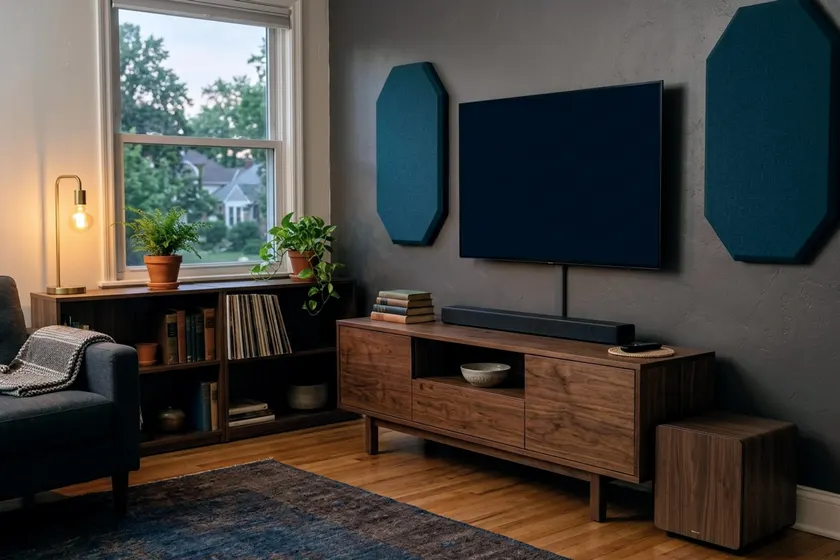
A soundbar with a subwoofer delivers clear dialogue and heavy bass for movie nights. You get room-shaking sound without running wires through your walls or mounting heavy boxes to the drywall. Separate speakers still win in a dedicated media room. Yet a bar and sub combination covers what many homes need.
What a soundbar and subwoofer setup does well
A soundbar packs the front channels of a movie soundtrack into a single enclosure. It sits flat on your television stand or mounts to the wall right below the screen. This puts the dialogue squarely in the center of the action. You hear actors clearly without riding the volume button between quiet and loud scenes.
A separate bass box handles the low frequencies that a slim bar cannot produce on its own. It takes over the heavy lifting for explosions, deep voices, and engine rumbles. The main bar can then focus on mid-range sounds and high notes.
Installation requires minimal effort. You plug one cable from the bar into your television, and you run another cord to a wall outlet. The bass box often pairs over a wireless signal and needs only its own power outlet. You skip the receiver, the speaker wire, and the heavy amplifier.
You need basic tools to mount the bar to the wall. You find a stud behind the drywall, drill your holes, and attach the brackets. Floating the bar a few inches below the screen looks clean and keeps the speakers pointed at your ears. You can hide the wires with a plastic raceway, and ask an electrician about in-wall outlets since a power cord does not belong inside a wall.
A home theater sound bar system saves floor space. You keep your room looking like a place to live rather than an electronics showroom. The main unit slides beneath the screen. The bass box tucks away near a sofa or behind a side table.
Where separate speakers pull ahead
A traditional setup uses an audio receiver connected to distinct speakers placed around the room. Compare a soundbar vs speakers, and you notice the physical distance between the left and right audio channels. A soundbar keeps all the front sound locked into a strip roughly the width of your television. Separate boxes sit several feet apart.
That extra distance creates a wider soundstage. You hear a car drive across the screen from one side of the room to the other. The audio matches the physical width of the picture much better. Standard soundbars can make the audio feel cramped in the center if you watch on a massive screen or a projector.
Separate units also offer a direct upgrade path. You replace just one piece if it breaks, or you swap in a stronger receiver. You can easily buy better front left and right channels later. A soundbar is usually a closed system, so a failed part can mean replacing the whole unit.
Standard speaker cabinets hold larger internal components. They often move more air and play louder without straining. This raw power fills massive basements easily. Individual speakers provide the volume and physical presence that movies demand if you want to build a dedicated media space.
Match the choice to your room size and layout
The shape of your room dictates how well any audio gear works. Sound waves bounce off the drywall, the ceiling, and the floor before they reach your ears. A single bar uses these hard reflections. It tricks your brain into hearing sound from the sides and above.
This bouncing effect works beautifully in a closed room with four walls and a flat ceiling. The audio bounces correctly if you watch movies in a spare bedroom or a standard enclosed living room. The sound wraps around your seating area and fills the total square feet of the space.
Open floor plans can weaken this effect. The side-firing audio has nothing to bounce against if your living room flows directly into your kitchen and dining area. The sound waves drift into the open space and dissipate. The surround effect can fade, and the audio may sound thin.
Vaulted ceilings cause similar problems. High, angled drywall sends upward-firing audio into the rafters. The sound never bounces back down to your seating position. Discrete speakers placed on stands or mounted directly to a stud perform better than a single bar in large open spaces with tall ceilings.
Furniture and window treatments also change the acoustics. Thick rugs and heavy curtains absorb sound, while bare floors and large glass windows reflect too much high-frequency noise. This creates a harsh echo. You might need to add soft materials to a sparse room to help the dialogue sound natural.
Pick the right connection for movie audio
How you connect your equipment changes the sound quality. Most televisions and bars use an HDMI cable. You look for the port labeled for audio return on both devices. This single cable passes audio from the television into the speakers.
Using the correct port usually lets the television remote control the volume. You press up on your standard remote, and the audio system responds. You avoid keeping track of a second remote control just to turn down loud commercials.
Older televisions might require an optical cable instead, which passes audio through a red light. It works well and delivers clear sound, but it cannot carry the heaviest audio formats used on modern discs. It may also mean using the audio remote to change the volume.
Bluetooth offers a wireless way to send sound from a television, but you should avoid it for movie nights. Wireless signals can introduce a slight delay. You watch an actor speak, and the sound reaches your ears a fraction of a second later. A physical cable usually keeps the picture and the sound closely matched.
Leave room to add rear speakers later
Buying a sound bar with subwoofer does not limit you to front-heavy audio. Many systems let you expand the setup down the line with wireless rear surrounds. You start with the basic package to handle daily television and movie nights. That keeps the upfront cost down.
You buy the compatible rear satellites when you want true surround sound. These small boxes sit behind your couch. They handle the background noise in a movie track. You hear rain falling behind you, footsteps approaching from the back, and planes flying overhead.
Plan your room layout with this future upgrade in mind. Wireless rear speakers still need electricity. Check your wall for an available outlet near the back of the room. You might need an extension cord running under a rug if your sofa floats in the middle of the floor.
Make sure you have physical space for the rear additions. They perform best placed slightly behind and to the sides of your main listening position. You can set them on bookshelves, mount them to the walls, or place them on dedicated floor stands. Leaving a few inches of clearance around your furniture makes it easier to figure out exactly where the boxes should go once you expand.
Place the subwoofer for even bass
Low frequencies behave differently than high frequencies. Bass waves are long and heavy, passing through furniture and rolling along the floor. You cannot easily tell where deep bass comes from. This means you do not have to place the box next to your television.
Hiding the box in a corner often creates the loudest bass. The sound waves hit the two intersecting walls and amplify into the room. This placement gives you extra rumble for action movies. It can also make the low notes sound muddy and overwhelming.
Pulling the box a few feet away from the corner helps tighten the sound. The bass becomes punchier and more precise. You hear the distinct notes of a bass guitar rather than a continuous low drone. Keep the box away from light fixtures or glass cabinets, as the vibrations will rattle them.
Try the crawl method to find the best location. Place the heavy box directly in your favorite chair or right on the sofa. Plug it in. Play a movie scene with heavy explosions and deep rumbles.
Get down on your hands and knees, and crawl around the perimeter of your room. Stop at the spots where you could realistically put the box. Listen closely at each location. You will hear that the bass sounds tight and even in some spots, but boomy or absent in others.
Mark the spot on the floor that sounds best to your ears. Move the box from the couch to that exact location. That spot gives you the evenest bass at your main seat.
Watch out for shared walls, since deep bass travels easily through standard framing. If you live in an apartment or share a wall with a sleeping child, placing the unit against that wall sends vibrations straight through the studs. A thick foam pad under it can cut the rumble that travels into the floor joists.
Keep checking your main electrical panel if you add more gear. These audio units usually draw little power. Running them on the same breaker as a space heater or window air conditioner could trip the circuit during a loud movie scene. Give your audio gear its own dedicated wall plugs where possible.