Where to put the speakers in a 5.1 surround sound system
Set up your 5.1 surround sound system with this placement guide to get clear dialogue and deep bass in your living room or dedicated home theater.
Filed by Alex Whitcomb 8 min
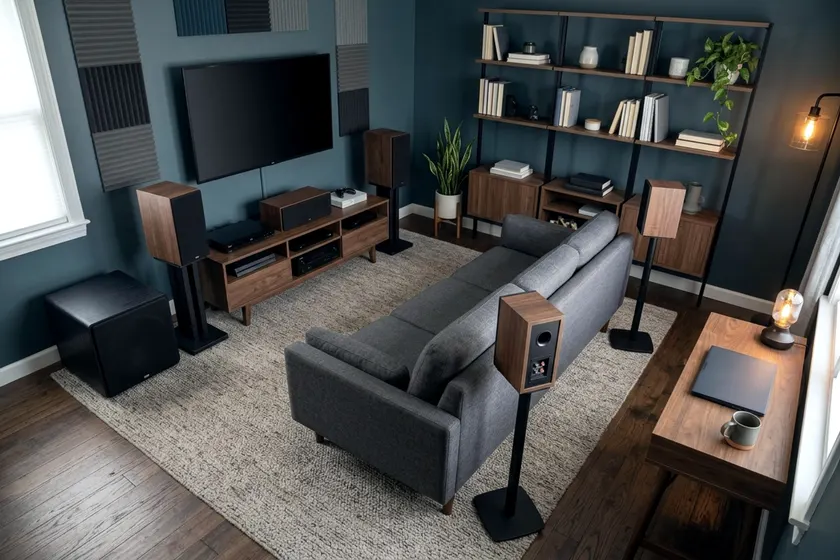
You get the best audio from a 5.1 surround sound system by aiming the speakers at a central seat and keeping them at ear level. You place the front and center channels near the screen and position the surrounds beside you. The subwoofer goes on the floor wherever the bass sounds smoothest.
What the numbers in a 5.1 setup mean
Audio equipment uses a simple numbering format to describe speaker layouts. In this system, the 5.1 figure counts the traditional surround speakers, such as front, center and surround. The .1 refers to how many powered subwoofers connect to the receiver.
The main five channels handle most of the sound. They play the music, the dialogue and the directional effects. The subwoofer takes care of the low-frequency effects. This is the deep rumble you feel during an action movie.
A powered subwoofer plugs into a wall outlet and connects to the receiver with an audio cable.
Your AV receiver acts as the brain for this entire setup. You strip the ends of your speaker wire and clamp the bare copper into the matching terminals on the back. The receiver then sends power and audio signals to every speaker.
If you want to plan a 7.1 surround sound speaker placement, you follow the same rules but add two extra surround speakers, usually behind the seat. A basic five-speaker layout can work well in many living rooms. It gives you a full blanket of sound without filling every corner with electronics.
Choose one main seat to aim the speakers at
You need a focal point to build the room's layout around. Choose a central seating point and angle your speakers at it. Find the middle cushion of your main couch, or set up a dedicated recliner facing the television. You will measure every speaker distance from this exact spot.
Audio waves sound best when they travel directly to you. Keep speakers at ear height when you are seated unless noted otherwise. You want the sound to hit your ears before it bounces off the ceiling, the floor or the coffee table.
Grab a tape measure, sit in your chosen seat, and find the distance from the floor to your ear. Use this measurement as the target height for your speakers. Small adjustments can make a big difference. This rule holds true if you build a dedicated home theater or a standard family room.
Position the front left and right speakers
Your front left and right speakers carry the musical score and the major sound effects. Place them on either side of your screen. They should sit an equal distance from the center of the television. If the left speaker sits several feet away from the screen, put the right speaker the same distance away on the other side.
Measure the distance between the two front speakers, and try to make that gap match their distance to your seat. This forms an equal-sided triangle with your head at the point. The spacing often gives good stereo separation, so music can sound like a live band playing in front of you.
Angle the front speakers inward
You need to point the speakers at your listening position. Turn the face of each speaker inward so it aims directly at the main seat. This angle creates a focused soundstage. Sound effects can pan smoothly from left to right as cars or planes move across the screen.
Keep them away from the walls
Pushing a speaker hard against a wall can create muddy sound, because bass notes bounce off the drywall and blur the audio. Pull your front speakers away from the back wall and the side walls.
If you use bookshelf speakers, place them on sturdy stands. Floor-standing tower speakers can sit right on the carpet, but you should still pull them forward a bit.
Put the center speaker above or below the screen
The center channel is the hardest working speaker in a movie setup. It plays most of the dialogue. When a character speaks, the voice should feel like it comes right out of the television. You want to place the center speaker straight ahead of your main seat, right in the middle of the screen.
Pull it to the edge of the furniture
Most people place the center channel on a media console beneath the television. This usually works well, but pull the speaker out to the front edge of the cabinet. If you push the speaker back against the wall, the sound can bounce off the flat wood in front of it and the voices can sound muffled.
Center channel speakers are heavy and wide, so measure your shelf space and check its weight rating before you move any furniture. A large speaker on a thin glass shelf can cause vibrations that distort the sound. Stick to solid wood or heavy metal stands. If you place it inside a tight cabinet opening, the enclosed space can echo and muddy the dialogue.
Angle the speaker toward your ears
Television screens usually take up the space at seated ear level. This forces you to place the center speaker lower down or mount it on the wall above the television. If the speaker sits low, slip a foam wedge or rubber feet under the front edge to tilt it up toward your face. If you mount it high, tilt it down.
Clear dialogue is the best reason to add this speaker. A dedicated center channel can ease the quiet voice problem that makes people wonder if a soundbar is enough in a large room.
Place the surround speakers beside or behind your seat
A 5.1 system uses two surround speakers to create ambient noise. They play the sound of rain falling, leaves crunching and crowds cheering. They can make the room feel bigger.
Position them on the sides
Surrounds often work best when you place them on the left and right sides of your seating area. Place them directly beside your main seat or just a tiny bit behind it. Face them straight across the room toward each other, or angle them slightly inward toward your ears.
Mount them at ear level
These speakers should sit at seated ear height. You can place them on tall speaker stands or mount them to the side walls. Wall brackets give you a clean look and keep the speakers safe from pets and vacuum cleaners. Anchor the brackets into a wall stud or use anchors rated for the speaker's weight, and follow the bracket maker's instructions so the speaker cannot fall.
Running the speaker wire from the receiver to the back of the room takes some work. You can tuck the wires under the baseboards or run them along the edge of a large rug. You might want to try some cable management tricks and apply those same ideas to your speaker wires.
The surround channels add texture to the movie track, so you do not want them overpowering the front speakers. Many home theater receivers include a small setup microphone. Place this microphone in your main seat and run the automated test tones. The receiver plays test tones through each speaker and adjusts the volume levels to balance them.
Find the best spot for your subwoofer
A home theater subwoofer handles the lowest notes. Bass frequencies are long audio waves that fill a room and bounce off large surfaces. Home theater subwoofer placement requires some patience. A spot that looks good might sound terrible.
Try the subwoofer crawl
You can find the best location with a simple trick. Do this:
- Place the heavy subwoofer right in your main seat.
- Play a movie scene with constant, deep bass.
- Get down on your hands and knees and crawl around the perimeter of the room.
- Listen carefully to the bass notes as you move to find where they sound tight and clear.
- Put a piece of tape on the floor to mark the best spot, and move the subwoofer there.
Common subwoofer locations
The front corners of a room often amplify bass. A corner spot gives the loudest rumble, but a spot along the middle of the front wall often delivers smoother sound. Keep the subwoofer box away from thin drywall and rattling cabinet doors. A heavy bass hit can shake loose objects and add rattles to the movie audio.
Hardwood floors and concrete basement pads can cause problems for subwoofers. Bass vibrations can travel through the floor to other rooms. You can place a thick rubber mat or a dense foam isolation pad under the subwoofer to decouple it from the floor. This may reduce the vibration that travels through the floor.
Fix a room layout with a couch against the back wall
Perfect placement is easy in a dedicated theater room. A standard living room presents more challenges. The most common problem is a main couch pushed flat against the back wall. You cannot place surround speakers behind the couch if the wall is in the way.
Mount surrounds on the side walls
If you have clear side walls, mount the surround speakers pointing directly across the couch at each other. Keep them at ear height. The sound will pass straight across the seating area. This setup creates a great sense of width and still handles surround sound effects well.
Mount surrounds high on the back wall
Sometimes a window, a door or a hallway blocks the side walls, forcing you to use the back wall. Mount the speakers directly above the couch. Place them higher up near the ceiling and angle them down toward your seat. This downward angle helps keep the sound from blasting right into the back of your head.
Pull the couch forward
You can often improve the audio by making a small change to the room layout. Pull the couch forward away from the wall. Even a small gap gives the sound waves room to move around you. This gap also provides physical space for small speaker stands.
A bare wall directly behind your head can create harsh echoes, since sound from the front speakers bounces off the drywall. Hang a heavy canvas painting, a thick blanket or some DIY acoustic panels on the wall behind the couch. These soft materials absorb the stray sound waves. This easy fix can make the dialogue clearer and tighten up the surround effects.